



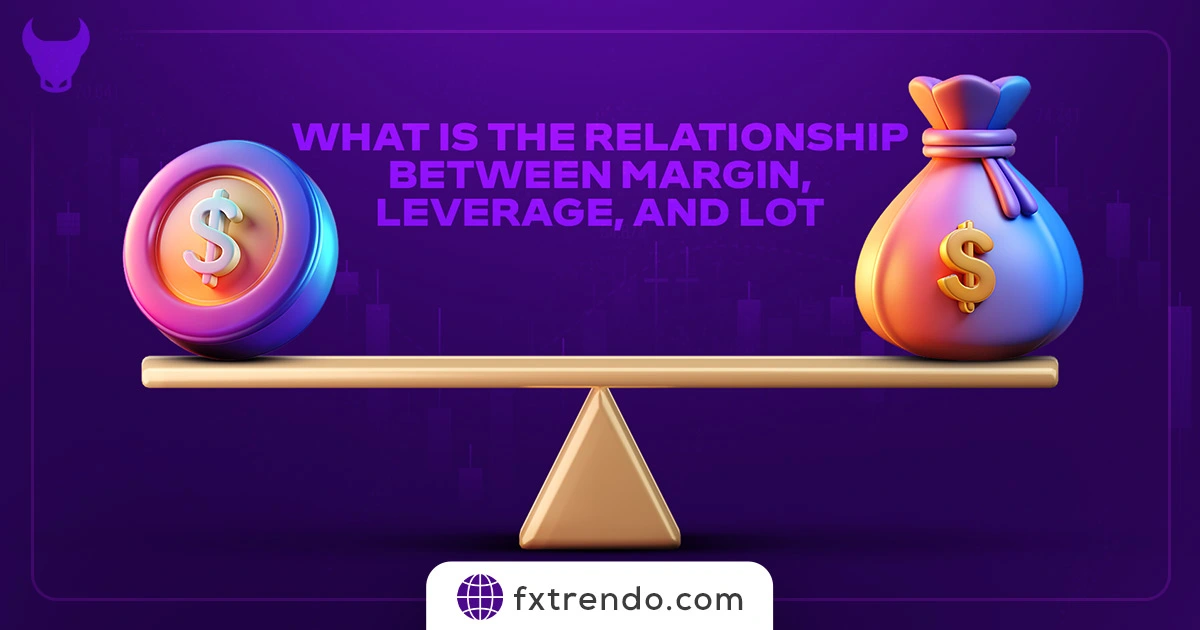
Margin refers to the amount of money required to open a position, while leverage allows traders to control a larger position with a smaller amount of capital. Lot size, on the other hand, determines the volume of the trade. By mastering the balance between these components, traders can optimize their risk management and enhance their trading performance.
In this blog post, we’ll delve into the nuances of margin, leverage, and lot size, and explore how they work together to influence your trading outcomes.
A clear grasp of margin vs leverage makes all the calculations and risk decisions much easier to manage. Whether you’re a novice or an experienced trader, this comprehensive guide to margin vs leverage will provide valuable insights to help you navigate the complexities of the trading world with confidence.
What is Margin?
Margin is essentially the money you borrow from a broker to purchase an investment. Understanding the margin vs leverage concept right from the start helps you see why only a small percentage of the trade value is needed as collateral. Think of it as a loan that allows you to buy more than you could with just your own funds.
When you trade on margin, you only need to put down a fraction of the total value of the trade, which is known as the margin requirement. This can amplify both your potential gains and losses.
Here’s a simple example: If you want to buy $10,000 worth of stocks but only have $5,000, you can use margin to borrow the remaining $5,000 from your broker.
This means you only need to provide 50% of the total value, and the broker covers the rest. However, it’s important to remember that trading on margin comes with risks. If the value of your investment drops, you could end up owing more than your initial investment.
Margin trading can be a powerful tool for experienced traders who understand the risks and rewards. It allows you to leverage your investments, potentially increasing your returns. However, it’s crucial to use margin wisely and be aware of the potential for significant losses.

How Margin Works in Different Markets?
Margin works differently across various markets, such as forex, stocks, and futures, but the core concept remains the same: it allows traders to borrow funds to increase their buying power.
Forex Market:
In the forex market, margin is used to open and maintain positions in currency pairs. When you trade forex on margin, you only need to deposit a small percentage of the total trade value, known as the margin requirement. This allows you to control a larger position with a smaller amount of capital.
For example, with a 1% margin requirement, you can control $100,000 worth of currency with just $1,000. However, trading on margin in the forex market can amplify both gains and losses, so it’s essential to manage risk carefully.
Stocks Market:
In the stock market, margin trading involves borrowing money from a broker to purchase stocks. You need to open a margin account and deposit a certain amount of money, which acts as collateral for the loan. The broker lends you the rest, allowing you to buy more shares than you could with your own funds.
For instance, if you have $5,000 and the broker offers a 50% margin, you can buy $10,000 worth of stocks. While this can increase your potential returns, it also comes with the risk of margin calls if the value of your stocks drops significantly.
Futures Market:
In the futures market, margin works a bit differently. Instead of borrowing money, you deposit an initial margin to open a futures contract. This initial margin is a small percentage of the contract’s total value. Additionally, you need to maintain a maintenance margin, which is the minimum amount required in your account to keep the position open.
If your account balance falls below this level, you’ll receive a margin call and need to deposit more funds. Futures margin helps ensure that both parties in the contract have a financial stake in the trade, reducing the risk of default.
How to Calculate Margin for Trading?
Calculating the margin for trading is a straightforward process, but it’s crucial to understand the formula and its components. The margin is calculated based on the lot size, the leverage, and the currency pair you’re trading.
Here’s the basic formula for margin calculation:
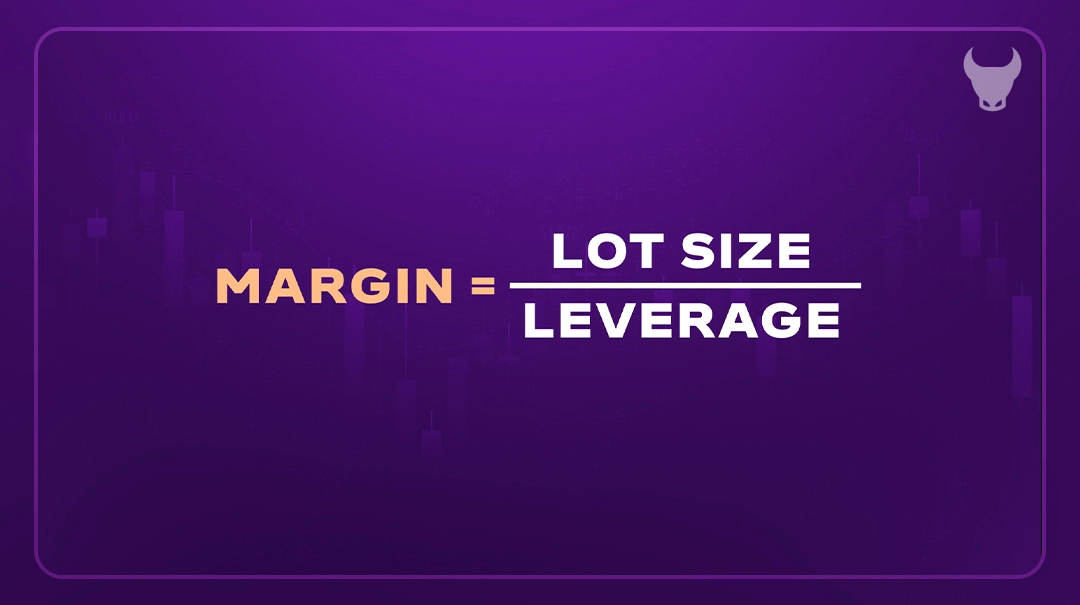
So, if you’re trading 1 standard lot of EUR/USD (which is 100,000 Euros) with a leverage of 1:100, the margin required to open this position would be:
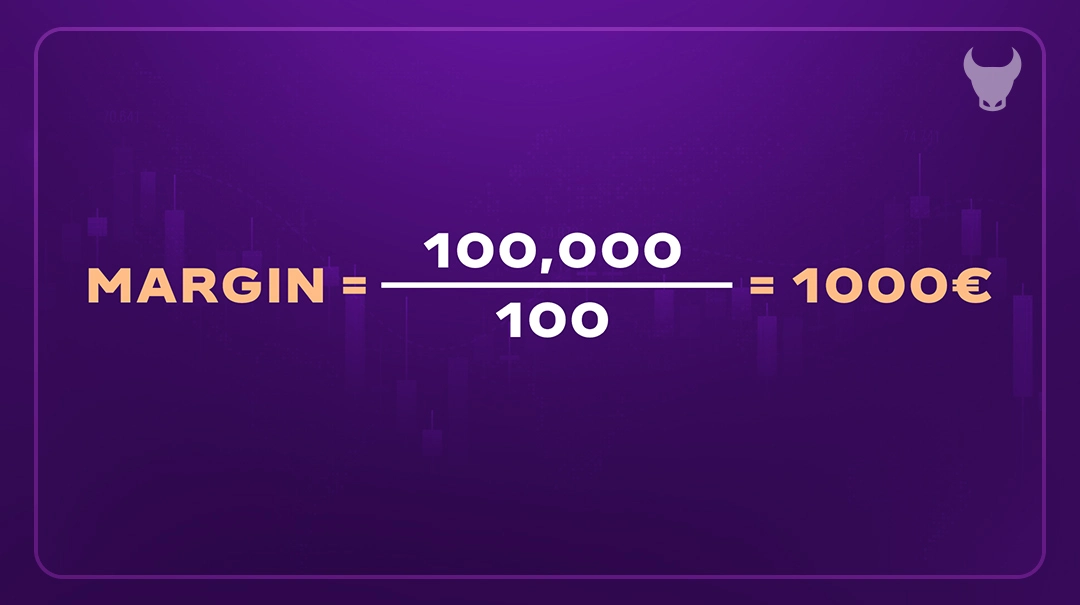
This means you need to have at least 1,000 Euros in your trading account to open this position.
Types of Margin in the Forex Market
In the forex market, understanding the different types of margin is crucial for effective trading. Here are the main types of margin you need to know:
1. Initial Margin:
This is the amount of money required to open a new position. It’s a small percentage of the total trade value and acts as a security deposit. For example, if the initial margin requirement is 2% for a $100,000 trade, you need to deposit $2,000.
2. Maintenance Margin:
Also known as the minimum margin, this is the minimum amount of equity you must maintain in your account to keep a position open. If your account balance falls below this level, you’ll receive a margin call, requiring you to deposit more funds to maintain the position.
3. Used Margin:
This is the portion of your account balance that is currently being used to maintain open positions. It represents the total amount of initial margin required for all your open trades.
4. Free Margin:
This is the amount of money in your account that is available for opening new positions. It’s calculated as the difference between your account equity and the used margin. Free margin acts as a buffer to absorb potential losses.
5. Margin Level:
This is a percentage value that indicates the health of your trading account. It’s calculated by dividing your equity by the used margin and multiplying by 100. A higher margin level indicates a healthier account, while a lower margin level may trigger a margin call.
What is Leverage?
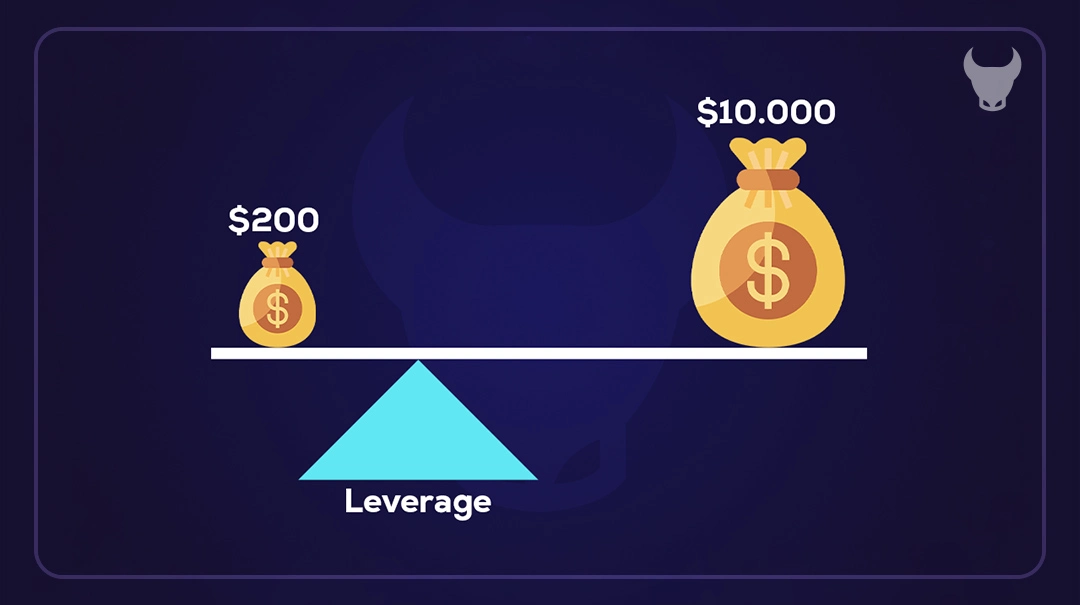
Leverage in trading is a powerful tool that allows you to control a larger position with a smaller amount of capital. When you compare margin vs leverage, you quickly realize that leverage is the multiplier that determines how much buying power you actually have.
Essentially, it’s like borrowing money from your broker to increase your buying power. This means you can potentially amplify your profits, but it also comes with increased risk.
Here’s a simple way to understand leverage and margin vs leverage terms: Imagine you have $1,000 in your trading account, and your broker offers you leverage of 10:1.
This means you can trade with $10,000 instead of just your $1,000. If the trade goes in your favor, your profits are magnified. However, if the trade goes against you, your losses are also magnified.
Read more:
What are The Differences between Leverage in Forex and Leverage in Crypto
Leverage is expressed as a ratio, such as 10:1, 20:1, or even higher. The higher the leverage, the greater the potential for both profit and loss. It’s important to use leverage wisely and understand the risks involved. While it can enhance your returns, it can also lead to significant losses if the market moves against you.
How Leverage Amplifies Trading Positions?
Leverage is a powerful tool in trading that allows you to control a larger position with a smaller amount of your own capital. This amplification can significantly increase both potential profits and potential losses. So, understanding the margin vs leverage term is essential.
Here’s how it works: When you use leverage, you’re essentially borrowing money from your broker to increase your buying power. For example, if you have $1,000 and your broker offers you leverage of 10:1, you can control a position worth $10,000. This means that even small market movements can have a big impact on your trading results.
Let’s break it down with a simple example. Suppose you invest $1,000 in a trade without leverage, and the market moves in your favor by 1%. Your profit would be $10.
However, if you use 10:1 leverage, that same 1% market movement would result in a $100 profit, because you’re controlling a $10,000 position. This is how leverage amplifies your trading positions.
Risks and Benefits of Using Leverage
Leverage can be a powerful tool in trading, offering both significant benefits and notable risks. Understanding these can help you make informed decisions and manage your trading strategy effectively.
Benefits of Using Leverage:
1. Increased Potential for Gains:
Leverage allows you to control a larger position with a smaller amount of capital. This means that even small market movements can result in substantial profits.
2. Access to Larger Positions:
With leverage, you can take larger positions than you could with just your own funds. This can help you capitalize on market opportunities that would otherwise be out of reach.
3. Enhanced Flexibility:
Leverage provides the flexibility to diversify your trading portfolio without needing a large amount of capital. This can help spread risk across different assets.
Risks of Using Leverage:
1. Magnified Losses:
Just as leverage can amplify gains, it can also amplify losses. If the market moves against your position, you could lose more than your initial investment.
2. Margin Calls:
If your account balance falls below the required margin level, your broker may issue a margin call, requiring you to deposit additional funds. Failure to meet a margin call can result in the liquidation of your positions.
3. Increased Volatility:
Leverage can increase the volatility of your trading account. This means that your account balance can fluctuate more dramatically, making it harder to manage risk.
4. Higher Costs:
Using leverage often comes with additional costs, such as interest on borrowed funds and higher trading fees. These costs can eat into your profits and increase your overall risk.
How to Calculate Leverage?
Calculating leverage in Forex trading is a straightforward process, resulting in better understanding the margin vs leverage concept. It’s typically expressed as a ratio, such as 1:100, which means that for every $1 of your own money, you can trade $100 on the Forex market.
But how do you calculate this ratio? The formula for calculating leverage is:
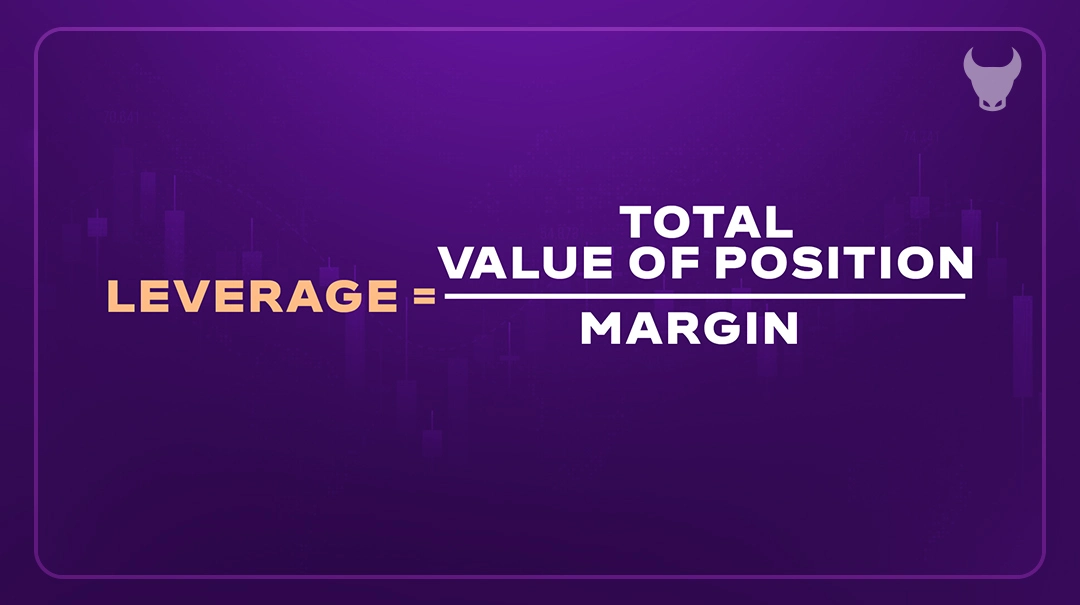
Let’s break it down:
Total Value of Position:
This is the total amount of currency you’re controlling in a trade. For example, if you’re trading 1 standard lot of EUR/USD (which is 100,000 Euros), the total value of the position is 100,000 Euros.
Margin:
This is the amount of your own money that is used to open the position. It’s essentially a good faith deposit, a collateral that you need to provide to ensure that you can cover the potential losses of the trade.
So, if you’re controlling a position worth 100,000 Euros and the margin required to open this position is 1,000 Euros, the leverage would be:
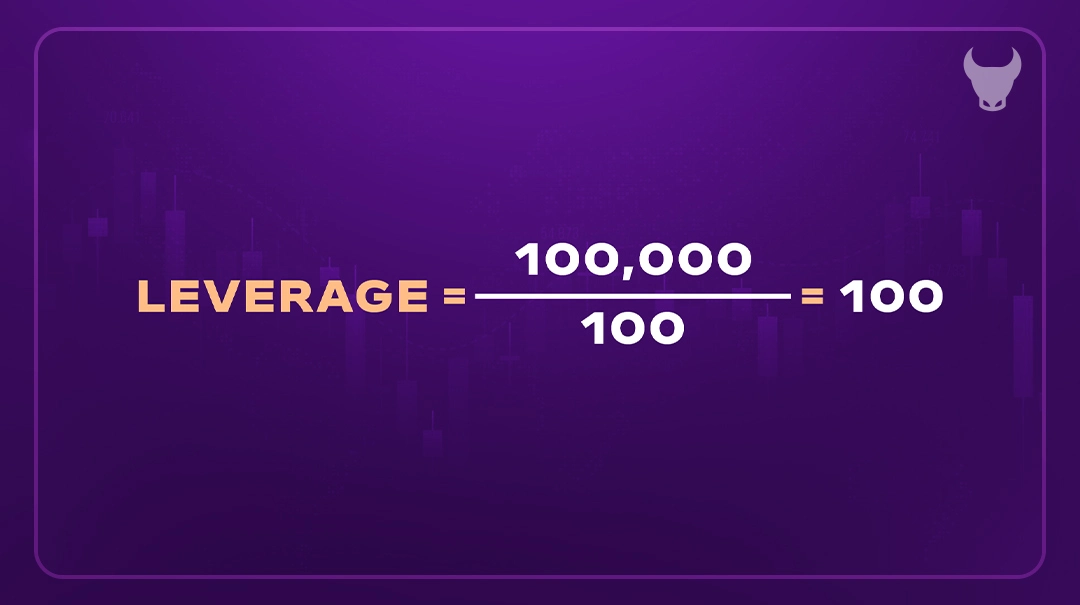
This means you’re trading with a leverage of 1:100.
How Margin, Leverage, and Lot Size Are Connected
In forex trading, the margin vs leverage relationship is fundamental to managing your account effectively. Traders must understand the margin vs leverage connection to determine how much market exposure they can take on. These elements directly influence risk and potential returns, especially when evaluating lot size and leverage decisions.
Higher leverage reduces the required margin (e.g., 1:100 needs 1% margin; 1:200 needs 0.5%). Larger lot sizes increase the margin required (e.g., 1 standard lot at 1:100 = $1,100 margin; mini lot = $110).
What is Lot Size?
Lot size refers to the number of units of a financial instrument, such as currencies, stocks, or commodities, involved in a transaction. In trading, lot size is a crucial factor as it determines the volume of the trade and, consequently, the potential profit or loss.
In the forex market, lot sizes are standardized to ensure consistency and ease of trading. There are four main types of lot sizes:
1. Standard Lot:
This is the largest lot size and equals 100,000 units of the base currency. For example, if you’re trading EUR/USD, a standard lot would be 100,000 euros.
2. Mini Lot:
A mini lot is one-tenth the size of a standard lot, equaling 10,000 units of the base currency. This smaller size allows traders to take smaller positions and manage risk more effectively.
3. Micro Lot:
A micro lot is one-tenth the size of a mini lot, equaling 1,000 units of the base currency. This is ideal for beginners or those with smaller trading accounts.
4. Nano Lot:
The smallest lot size, a nano lot equals 100 units of the base currency. This allows for very small trades and is often used for testing strategies with minimal risk.
Margin Calculation Tables for Different Leverage and Lot Sizes
The following margin calculation tables help traders quickly understand the practical relationship between their trading capital, position size, and risk. These tables clear up a lot of confusion regarding margin vs leverage by presenting concrete examples of how much money is actually locked up when opening trades.
One common area where traders feel vague is how dramatically leverage vs lot size and lot size vs leverage interact. Increasing your lot size doesn’t just add a little more risk — it multiplies both your margin requirement and your exposure to every price move.
This is why comparing leverage trading vs margin trading becomes so important for long-term success.
Margin Table for Leverage 1:50 to 1:1000 (1 Standard Lot EUR/USD at 1.1000)
| Leverage | Required Margin |
|---|---|
| 1:50 | $2,200 |
| 1:100 | $1,100 |
| 1:200 | $550 |
| 1:500 | $220 |
| 1:1000 | $110 |
Table Showing Lot Size Impact on Required Margin (At 1:100 Leverage, EUR/USD at 1.1000)
| Lot Size | Required Margin |
|---|---|
| 0.01 | $11 |
| 0.1 | $110 |
| 0.5 | $550 |
| 1.0 | $1,100 |
As these tables show, even small changes in lot size can have a massive impact on your account. This is exactly why grasping the pips meaning is essential. It tells you the real monetary value behind each price movement and helps you manage risk effectively when deciding your forex lot size vs leverage combination to protect your capital.
Common Mistakes Traders Make with Margin and Leverage
Many traders run into serious trouble because they fail to fully respect the relationship between margin, leverage, and position sizing. Understanding these common pitfalls can save your account from unnecessary losses and help you trade more safely.
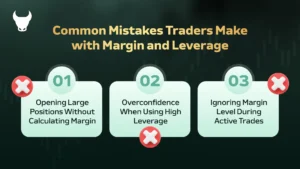
Opening Large Positions Without Calculating Margin
A very common error is opening big positions without properly calculating the required margin first. Traders often rely on guesswork and suddenly find their account locked with little free margin left. Always calculate the exact margin needed before entering any trade. This simple step prevents nasty surprises and margin calls.
Overconfidence When Using High Leverage
Many traders get overconfident when using high leverage. They see the potential for big profits and forget how quickly losses can grow. High leverage is a double-edged sword. Stick to leverage levels that match your experience and risk tolerance instead of chasing maximum exposure.
Ignoring Margin Level During Active Trades
One of the costliest mistakes is ignoring your margin level after trades are open. As the market moves against you, your margin level can drop fast, leading to forced closures. Make it a habit to monitor your margin level regularly, especially during news events or high volatility. Set alerts if possible.
Avoiding these mistakes will dramatically improve your risk management and trading consistency.
Practical Tips for Traders
Navigating the world of Forex trading can be a complex journey. Here are some practical tips to help you manage your trading effectively and optimize your potential returns:
1. Understand the Basics:
Before you start trading, make sure you have a solid understanding of the basic concepts such as margin vs leverage and leverage vs lot size. These elements play a crucial role in determining your trading capacity and risk level.
2. Choose the Right Leverage, based on margin vs leverage
While leverage can amplify your profits, it can also amplify your losses. Choose a leverage level that aligns with your risk tolerance and trading strategy.
3. Manage Your Margin Effectively:
Margin is the amount of your own money that is used to open and maintain a position. Make sure you have enough margin to cover potential losses and avoid margin calls.
4. Select the Appropriate Lot Size:
The lot size you choose determines the volume of your trade and the level of risk you’re exposed to. Choose a lot size that aligns with your risk tolerance and trading capital.
5. Use Stop Loss and Take Profit Orders:
These are tools that can help you manage your risk effectively. A stop loss order automatically closes your position if the price reaches a certain level, limiting your potential loss. A take profit order automatically closes your position when the price reaches a certain level, securing your profit.
6. Stay Informed:
Keep up-to-date with market news and economic events. These can have a significant impact on currency prices.
7. Practice Risk Management:
Never risk more than you can afford to lose. A common rule of thumb is to never risk more than 1-2% of your trading capital on a single trade.
8. Keep Learning:
The Forex market is dynamic and constantly changing. Continuous learning and adaptation are key to successful trading.
Conclusion
In summary, understanding the margin vs leverage concept is crucial for successful trading. These three elements are interconnected and play a significant role in shaping your trading strategy and risk management. Experienced traders constantly evaluate margin vs leverage before adjusting their lot sizes.
Margin is the amount of money required to open a position, leverage allows you to control a larger position with a smaller amount of capital, and lot size determines the volume of the trade.
By mastering these concepts, traders can optimize their strategies, manage risks effectively, and make informed decisions.
Whether you’re a beginner or an experienced trader, a solid grasp of margin vs leverage vs lot size will empower you to navigate the complexities of the trading world with confidence.