

The week ahead will be pivotal for global financial markets, with several major and market-moving events that could shape the direction of the US dollar, the euro, and gold in the months to come. The most important event this week is the US Federal Reserve meeting on January 28. Interest rates are expected to remain unchanged, but the tone of Jerome Powell, the Fed Chair, may provide key clues about the path of monetary policy in 2026. Meanwhile, gold has maintained its upward trend and, after setting fresh all-time highs, is trading above the $4,950 per ounce area.
US Dollar Index Analysis
At the start of 2026, the US Dollar Index has come under pressure and is fluctuating in the 97–98 range—around 10% below its 2025 highs. This weakness is largely driven by market expectations for interest rate cuts later this year, concerns over US government debt, and uncertainty surrounding the Trump administration’s trade policies.
The key event of the week is the Federal Reserve meeting on January 28. There is a strong probability that the policy rate will remain unchanged in the 3.50% to 3.75% range—marking a second consecutive pause following three rate cuts in the second half of 2025. While PCE inflation remains near 2.8% and above the 2% target, December employment data—showing only 50,000 new jobs—signals economic softness and makes the policy outlook more sensitive.
From a technical perspective, the Dollar Index is trading below its 200-day moving average, confirming bearish pressure. Major support levels are seen at 97.50 and then 96, and a break below these zones would increase the likelihood of further downside.
EUR/USD Analysis
EUR/USD has been volatile at the beginning of 2026 and is trading within the 1.16–1.18 range. On the monetary policy front, while the possibility of Fed rate cuts is being discussed, the European Central Bank is expected to keep its policy stance unchanged for now.
A MUFG report suggests that EUR/USD could trade above 1.20 during the current cycle, citing the return of foreign capital to European markets, stable monetary policy, and inflation close to target as supportive factors for the euro. Geopolitically, the suspension of Trump’s proposed tariffs has eased part of the pressure on the euro, but uncertainty around US trade policy remains a risk. From a technical standpoint, the upper boundary of an ascending triangle pattern sits near 1.1820, and a breakout could trigger further upside, while the key support zone lies between 1.1620 and 1.1635—where a breakdown would raise the probability of a decline toward 1.1500. This week, data such as PMI releases and European employment figures will be important drivers for market direction.
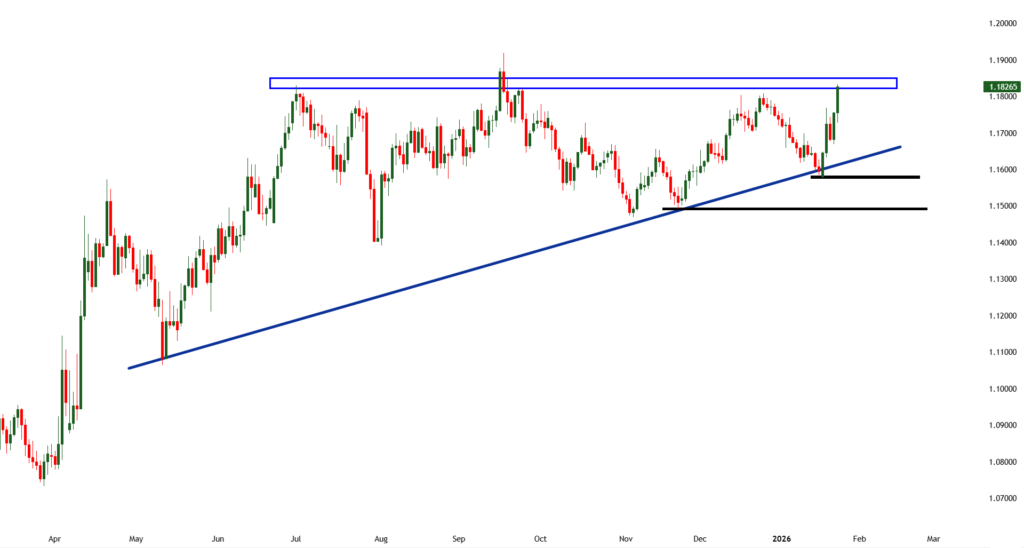
EUR/USD Technical Analysis
XAUUSD Analysis
In 2026, gold has extended last year’s powerful bullish trend and has printed new all-time highs. On Friday, spot gold moved above $4,950 per ounce, posting one of its strongest weekly performances since March 2020. This rally has been fueled by geopolitical risks, a weaker US dollar, and rising demand from investors and central banks.
Major banks have also reinforced the bullish outlook: JPMorgan has set a target of $5,055 by the end of 2026 and $5,400 by the end of 2027, while Goldman Sachs has raised its end-2026 forecast to $5,400. Continued central bank buying—particularly across emerging markets—remains one of the main drivers, while inflows into gold ETFs in the West indicate that institutional demand is still strong. Expectations of Federal Reserve rate cuts and a weaker dollar have also increased gold’s appeal as a safe-haven asset.
Despite warnings from some analysts about the risk of heavy corrections similar to those seen in the 1980s, the broader outlook remains bullish, and some projections even point to much higher targets. Technically, gold broke above an ascending triangle in January and has stabilized at record highs. A key support zone is located between $4,600 and $4,700, and price action around this area may determine the market’s next move.
Japanese Yen and Bank of Japan Decision Analysis
At its January 23 meeting, the Bank of Japan kept its short-term interest rate unchanged at 0.75%, the highest level since September 1995. The decision was approved by an 8–1 vote, with Hajime Takata being the only member calling for a hike to 1%. This cautious stance was adopted ahead of the early February election, which could increase political pressure to maintain supportive policies.
In its quarterly report, the BOJ upgraded its economic growth forecasts, projecting 0.9% growth for fiscal year 2025 and 1% for fiscal year 2026. These revisions were attributed to support from the trade agreement with the US and Tokyo’s fiscal stimulus package. Kazuo Ueda also emphasized that if the economy and inflation evolve in line with forecasts, the path of rate hikes will continue. At the same time, he stressed the importance of assessing the impact of each step before making the next decision—highlighting the bank’s cautious approach.
Many analysts expect the next rate hike to come in October 2026, unless sharp yen weakness brings the timeline forward. If USD/JPY moves toward 160, the likelihood of Japanese government FX intervention increases. Following the BOJ decision, USD/JPY climbed above 158, and technically, a move back below 150.83 could signal a weakening uptrend and a strengthening yen. As a result, Japan’s inflation and employment data, along with political developments ahead of the election, will be key in shaping the market’s next direction.
Final Thoughts
Overall, the week ahead will be marked by a strong market focus on the Federal Reserve meeting, key European data releases, and continued volatility in gold and major currencies. The Dollar Index is sitting at sensitive technical levels, EUR/USD is approaching a critical breakout zone, and gold—while holding its bullish trend—remains in focus as a safe-haven asset for investors. In these conditions, traders should stay prepared for trading opportunities by applying disciplined risk management and closely monitoring the Trendo Forex economic calendar.
Download the Trendo trading platform and trade gold with spreads below 1 pip