




The psychology of trading in competitions plays a highly significant role, because the competitive environment, time limitations, and constant comparison with others push a trader’s behavior out of its normal state and lead to impulsive, emotional decisions that deviate from their strategy. If excitement and stress are not managed, they quickly influence the trader’s overall performance.
In this article, we examine exactly this psychological dimension of competitions and provide practical solutions for managing the mind, reducing pressure, and maintaining focus, so a trader can act logically and consistently even in competitive conditions. Stay with us.
What Is a Trading Competition and How Does It Differ from Regular Trading?
A trading competition is a fully competitive environment where traders attempt to achieve the highest return using a fixed amount of capital within a limited period. This structure creates behavior and decision-making patterns that differ greatly from normal conditions.
In competitions, there is not enough time for long analyses, and this speed increases the likelihood of emotional decisions. In addition, to avoid falling behind competitors, many traders use a larger-than-usual position size, which increases account volatility and raises the risk of heavy losses or margin calls.
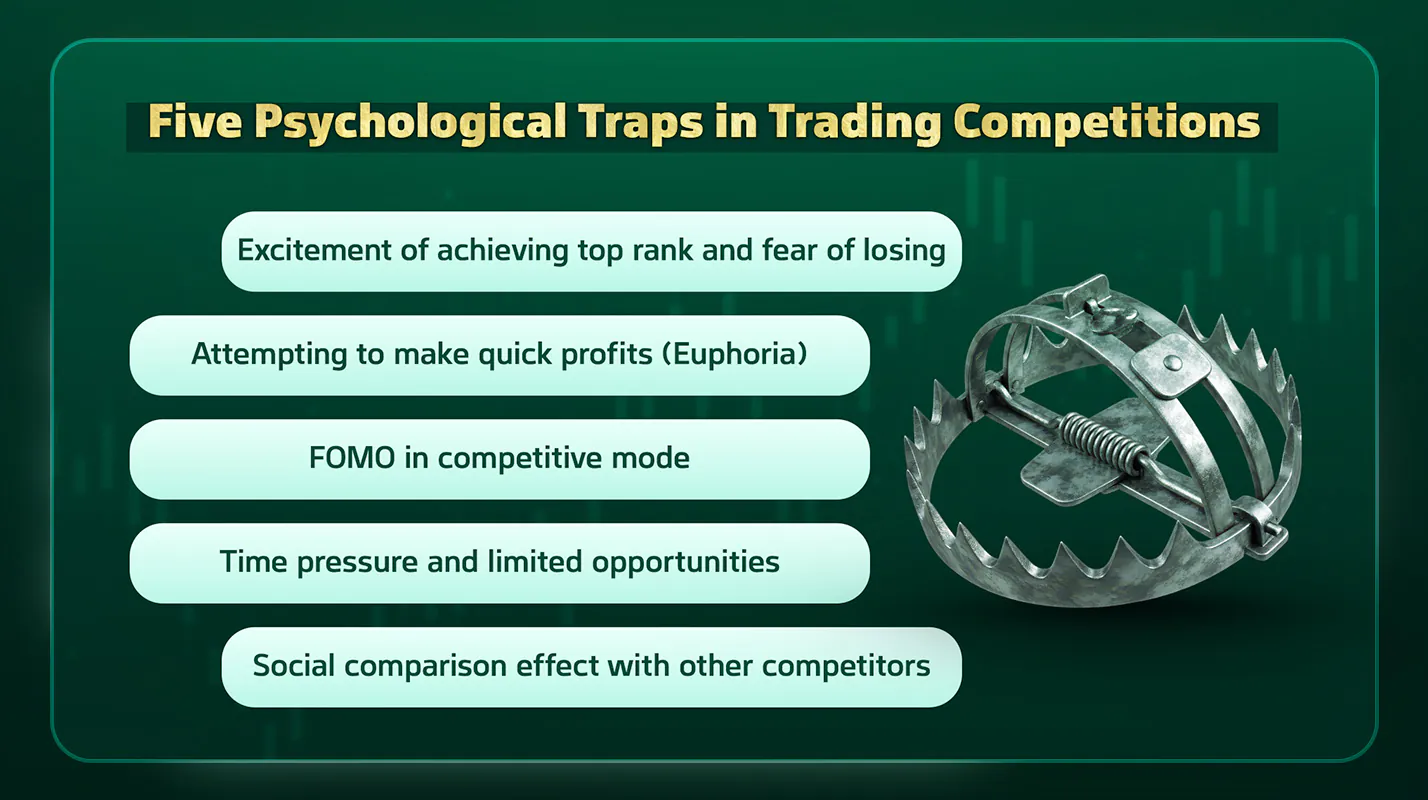
Five Psychological Traps in Trading Competitions
-
The excitement of reaching top ranks and the fear of losing
-
The urge to chase quick profits (Euphoria)
-
Competitive FOMO
-
Time pressure and limited opportunities
-
The effect of social comparison with other competitors
1) Excitement of Achieving Top Rank and Fear of Losing
During competitions, the mind naturally shifts toward “result-orientation”—instead of focusing on decision quality, attention is drawn to rank and placement. The limbic system reacts emotionally when comparing your current position to others: excitement from progressing to a higher rank and fear of falling behind. The combination of these conflicting emotions pushes traders toward irrational risks, impulsive entries, and premature exits.
2) The Desire to Achieve Big Profits (Euphoria)
Quick and large profits release substantial dopamine due to the immediate reward they create. This state of euphoria produces a false sense of control and overconfidence: the trader feels they fully understand the market and believes trends will always follow their expectations. This is where the real danger begins—position sizes increase, and stop-loss rules are ignored.
3) FOMO in Competitive Conditions
In competitions, FOMO becomes much stronger than in normal trading. When a trader sees others profiting and changing ranks, they naturally compare themselves to them. This instant comparison creates the feeling: “If I don’t enter now, I’ll fall behind.” The result is unplanned entries, buying at peaks, selling at bottoms, and experiencing intense emotional swings.
4) Time Stress and Limited Opportunities
Limited time in competitions significantly increases decision-making pressure. Under stress, the brain defaults to mental shortcuts and fast pattern-based decisions rather than logical reasoning.
This greatly increases the likelihood of mistakes and can lead the trader to ignore their primary trading strategy.
5) The Effect of Social Comparison With Other Competitors
In competitions, traders constantly compare themselves to the ranks and performance of others. This comparison triggers emotions such as inadequacy, greed, or anxiety. The pressure shifts focus from “executing the strategy correctly” to “proving one’s ability,” which is the foundation of risky and unsystematic behavior.
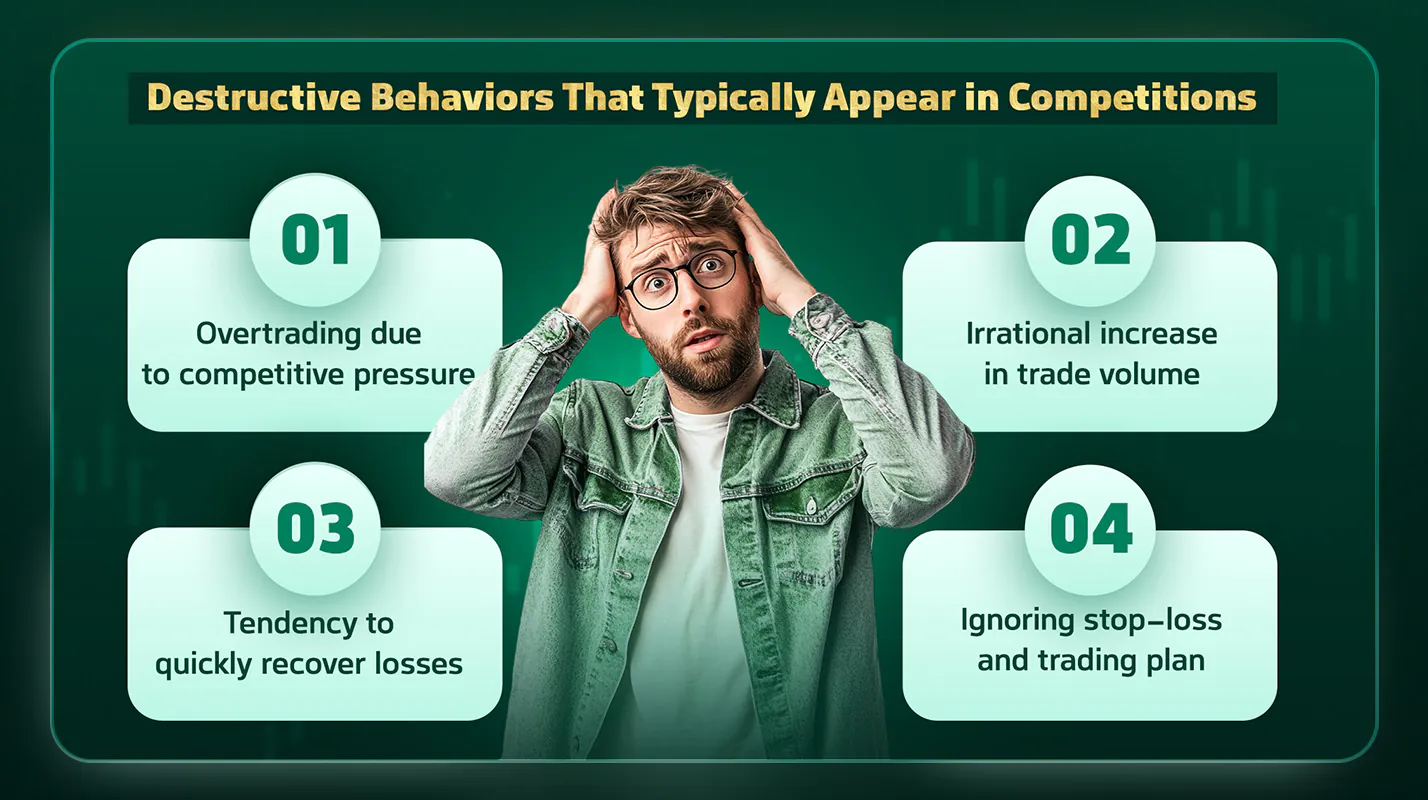
Destructive Behaviors That Commonly Appear in Competitions
-
Overtrading due to competitive pressure
-
Irrational increase in position size
-
Urge to quickly recover losses
-
Ignoring stop-losses and the trading plan
In competitions, time pressure, emotional intensity, and the need to rapidly increase balance push many traders away from logical behavior and into high-risk cycles. These internal and external pressures shift the trader’s focus from “executing the strategy precisely” to “trying to outrun competitors,” activating four major destructive behaviors described below.
1) Overtrading Due to Competitive Pressure
In competitive environments, the trader’s mind constantly seeks the “next opportunity” to avoid falling behind. This stress leads the trader to enter trades that do not match their system criteria.
Overtrading usually results from:
-
Anxiety about rankings
-
Lack of patience
-
Attempting to grow account balance quickly
Its outcomes include reduced analytical accuracy, mental fatigue, and lower decision-making quality.
2) Irrational Increase in Position Size
To make a rapid jump in rankings, many traders take position sizes they would never consider in normal trading—behavior driven solely by competitive pressure. Increasing lot size without proper risk management amplifies account volatility and can turn a small mistake into a major loss or even a margin call.
3) Urge to Quickly Recover Losses
When a trader experiences losses during the competition, the mind applies pressure to immediately return to the previous rank—this is revenge trading. Logical analysis disappears and emotional behavior takes over: entering trades without reanalyzing the market, shifting stop-loss levels, or increasing position size in an attempt to recover quickly. This cycle almost always leads to even larger losses.
4) Ignoring Stop-Loss and the Trading Plan
One of the most common deviations in competitions is ignoring the stop-loss or adjusting it when price approaches it. Competitive pressure and the desire for higher risk make the trader think: “Price will eventually come back.” Additionally, many traders completely abandon their trading plan and enter trades they would never consider under normal circumstances. The result: increased risk, account disorder, and loss of psychological control over the trading process.
Trading Psychology Strategies for Competitions

To succeed in competitions, analytical skill alone is not enough; the trader must also build a strong psychological framework. This includes designing a trading strategy, defining risk boundaries, enforcing non-negotiable rules, and actively managing stress. Techniques such as emotional control, minimizing distractions, and continuously reviewing one’s strategy help the trader withstand competition pressure and keep decisions logical.
1) Following a Tested Strategy
In competitions—and in all trading—you must follow a tested and profitable strategy. The first step is defining risk boundaries: determine the maximum loss you accept, what position size is appropriate, and at what drawdown you will stop trading. These boundaries create a stable framework that prevents emotional decision-making under pressure. The next step is defining non-negotiable rules—those you must never break, even under stress or near the end of the competition. Examples: mandatory stop-loss, no entry without a complete setup, or limiting daily trades.
These rules serve as your psychological shield, preventing your behavior from drifting away from logic during peak excitement.
2) Managing Anxiety and Stress in Trading Competitions
In competitions, controlling anxiety is an essential part of your trading strategy because it directly impacts decision quality. After any major win or loss, emotional management is crucial.
Taking a short break from the chart, drinking water, or writing down your emotions helps calm your mind and restore logical thinking. To prevent pressure from reducing your accuracy, you must preserve focus. By removing unnecessary charts, paying less attention to rankings, and briefly reviewing your strategy before each trade, you can maintain mental alignment with your plan.
3) Controlling Emotions After Big Wins in Trading Competitions
Leading the competition often comes with increased dopamine and false confidence, which quickly distances the trader from their strategy. To avoid this trap, set a mandatory break after any major jump in ranking—step away from the chart for a few minutes to cool down and ensure upcoming decisions are not influenced by a sense of superiority. Reviewing your strategy and rules helps realign your mind. Keeping a trading journal also shows that account growth results from strategy adherence, not luck.
4) Controlling Emotions After Big Losses in Trading Competitions
Falling behind in rankings often places the mind in an “emergency” state, causing traders to seek quick recovery instead of logical decision-making. The first step is interrupting the reaction cycle—after any loss or ranking drop, step away from the chart for several minutes to let emotions settle. Then, by reviewing your plan and non-negotiable rules, you guide your mind back into the proper framework. Reanalyzing the market and entering only valid setups prevents impulsive trades. Instead of trying to recover quickly, focus on executing each trade correctly. When the mindset shifts from “I must recover” to “I must trade correctly,” decision quality stabilizes and gradual improvement in rankings becomes more likely.
Trendo’s Big Trading Competition: From Black Friday to Christmas
Trendo’s major trading competition has begun—from Black Friday to Christmas—and is now underway.
This exciting event allows traders to showcase their skills, strategies, and creativity while competing for higher returns and valuable prizes.
It is a unique opportunity for all Trendo users to grow their accounts and win attractive cash rewards.
At the end of the competition, the top three traders with the highest profit percentages will receive:
-
1st Place: $500
-
2nd Place: $300
-
3rd Place: $200
But the excitement does not stop there. Trendo has also organized a $500 lottery, where 10 participants will be selected randomly, and each will receive $50. So even if you are not among the top three, you still have a chance to win.
For details and registration, visit the following page:
Trendo’s Going Black Campaign: From Black Friday to Christmas 2025
Final Words
Trading competitions are neither a game of luck nor a place for momentary excitement; success comes from a combination of analytical skill, mental discipline, and emotional control. A trader who remains committed to their plan under pressure, controls the excitement of fast profits, avoids impulsive reactions to sudden losses, and shifts focus from “ranking” to “correct execution,” has a much higher chance of achieving stable results.
A competition may be short, but its psychological effects last long after—it shapes trading behavior. Thus, mastering trading psychology in competitions is not just about winning prizes; it is essential for becoming a mature and professional trader.
Register with Trendo Broker and Join the Trading Competition