




Trading competitions have become an exciting arena where traders, within a limited timeframe, strive to achieve the highest returns using optimal strategies and professional risk management. These contests are not just a test of technical skills; they also evaluate fast decision-making, emotional control, commitment to a trading plan, and the ability to perform under pressure.
In this article, we explore trading competitions, the core criteria for success, and real strategies used in these events—helping you build a clearer path toward achieving top results. Stay with us.
What Are Trading Competitions and Why Have They Become So Popular?
Trading competitions are events where participants trade with real capital or a demo account over a defined period and compete based on metrics such as highest return, lowest risk, or best trading strategy.
The main purpose is to assess skill, capital management, and the trader’s ability to make rapid decisions under real market conditions.
Trading competitions have gained wide popularity for several reasons:
- The opportunity to win substantial prizes without large capital requirements
- A controlled and competitive environment to test trading strategies
Types of Trading Competitions
Trading competitions vary depending on purpose, platform, and evaluation method. They generally fall into several main categories:
1) Demo Account Competitions
Risk-free trading with fully realistic market conditions. These are ideal for testing strategies, practicing risk management, and assessing skill before entering higher-stakes events.
2) Real Account Competitions
Designed for professional traders seeking real profits and major prizes. Here, capital management and strict control over losses play the most critical roles.
3) Return-Based Competitions
The ranking is based on the highest return during a specified period. Participants must use strategies that generate high profits while keeping drawdown low.
4) Volume-Based Competitions
Winners are determined by trading activity. Styles such as scalping or rapid trading tend to excel here, as trade volume matters more than the percentage return.
The Difference Between Demo and Real Competitions
In demo competitions, traders use virtual money—meaning no psychological pressure and more logical, decisive actions. These events help evaluate strategies, optimize trading systems, practice risk management, and build practical experience.
By contrast, in real competitions the trader’s actual capital is at stake. Emotional factors—fear of loss, excitement from fast gains, and competitive pressure—directly influence decision-making.
Key Traits of a Successful Competition Trader
- Fast decision-making
- Discipline and strict risk management
- Mastery of analytical tools
- Emotional control in high-pressure situations
A successful competition trader must act quickly, execute precisely, and avoid emotional behavior under competitive pressure. Skill in analysis, capital management, selecting high-quality setups, and sticking to a strategy ultimately shapes the final outcome.
Fast Decision-Making
A professional trader must quickly analyze the chart, identify valid setups instantly, define stop-loss and target levels accurately, and execute trades without delay. Even a one-minute hesitation can be the difference between entering at the optimal point and stepping into a high-risk position.
Discipline and Strict Risk Management
No trader succeeds with disorder or excessive risk-taking. A strong competitor constantly controls stop loss, position size, and the allowed risk per trade—ensuring that competitive excitement does not lead to overtrading or irrationally large positions. Discipline means that in both winning and losing phases, the trader remains committed to the plan and follows capital-management rules without emotional interference.
Mastery of Analytical Tools
To capture the best market opportunities, a trader must combine capital management and emotional control with strong analytical skills. This includes:
- Price Action
- Candlestick patterns
- Trend identification
- Support and resistance zones
- Complementary indicators and confluence signals
This mastery ensures the trader selects only those setups with a high probability of success.
Emotional Control Under Competitive Pressure
Competition increases stress and mental pressure, often pushing traders toward impulsive entries, emotional exits, or revenge trading. A professional trader understands that emotional management is a key part of a winning strategy. By maintaining composure, respecting stop losses, waiting patiently for valid setups, and avoiding emotional reactions, they keep the quality of their trades consistently high.
Principles of Designing a Winning Strategy
- Choosing the right timeframe for the competition
- Focusing on high-probability setups
- Using a high risk-to-reward ratio
To build a winning strategy for trading competitions, a trader must combine precision, speed, and professional risk management. Selecting the correct timeframe, entering only high-quality trades, setting realistic targets, and actively managing open positions allow the trader to maintain stable and low-risk performance in competitive conditions.
Choosing the Right Timeframe for the Competition
The timeframe should be selected based on the type of competition and the level of speed required. In short-term contests, lower timeframes such as 5-minute and 15-minute provide more trading opportunities and allow for fast entries into momentary setups. In longer competitions, using 1-hour or 4-hour timeframes improves analytical accuracy and reduces the risk of false volatility.
Focusing on High-Probability Setups
In trading competitions, every trade matters. Therefore, a trader must enter only setups that are tested, reliable, and have a high win rate. Setups such as valid breakouts, reversals from support and resistance zones, and confirmed price-action patterns generally offer the highest probability of success.
Using a High Risk-to-Reward Ratio
One of the most important principles in trading competitions is selecting trades with an attractive risk-to-reward ratio. Ratios such as 1:2, 1:3, or higher ensure that even with a limited number of trades, the final profit remains strong and drawdown stays controlled. This approach helps the trader achieve maximum returns with minimal risk.
The Best Strategies Used in Trading Competitions
Almost all new traders start on the wrong path: endlessly searching for “the best strategy.” But professionals share a simple truth:
In financial markets, there is no such thing as one ultimate strategy.
There is no universal system that works for every trader. Each participant must choose and customize a strategy based on experience level, risk tolerance, starting capital, decision-making speed, and the type of competition. What is profitable for one trader may be too risky or ineffective for another. The key point is to avoid falling into the endless cycle of chasing new and complex strategies. Many traders lose the opportunity to master or optimize their system simply because they switch methods too often. A professional strategy is not necessarily complicated; in fact, the simplest systems—such as trading support and resistance, valid breakouts, or confirmed price-action setups—are often the most effective in competitions.
The focus should be on consistency, risk management, execution speed, and disciplined adherence to the rules—not on stacking unnecessary indicators or building overly complex systems. Still, below are several well-known and practical strategies that will give you a clearer view of the common approaches used in trading competitions. These strategies serve as starting points, and you should customize them based on your style, risk profile, and the conditions of the competition.
1) Momentum Trading Strategy
The momentum strategy means following strong market movement and capturing profit before the trend slows down. In trading competitions, it can be applied through four simple steps:
Step 1: Identify the Market and the Momentum Direction
First, focus on symbols with high volatility and trading volume, because strong momentum typically appears in these markets. Then determine the momentum direction using price trends, chart slope, breakout of previous highs or lows, or even indicators such as RSI and Moving Average. This reveals whether the market is in a strong bullish phase or a sharp bearish phase.
Step 2: Find the Entry Point in the Direction of the Strong Move
After identifying momentum, the next step is selecting an entry. Entries are typically made on breakouts of previous highs, shallow pullbacks in the trend direction, or strong continuation candles. The key is to always trade in the dominant direction—not against it. At this stage, the stop-loss should be placed behind the most recent significant swing low or swing high.
Step 3: Set Targets with an Attractive Risk-to-Reward Ratio
Before placing the trade, the target must be defined to ensure a desirable risk-to-reward ratio—such as 1:2 or 1:3. In momentum trading, targets are usually set at the next support or resistance zone, or based on multiples of the stop-loss distance.
Step 4: Manage the Position During the Move and Exit on Time
As price moves in the direction of momentum, you can lock in profit by gradually trailing the stop (Trailing Stop) or by closing part of the position (Partial Close). If clear signs of weakening momentum appear—such as strong reversal candles or slowing movement—you should exit the trade without hesitation.
For example, as shown in the image below from the Trendo platform, the market initiates a sharp move with a strong bearish candle, and the RSI suddenly drops below the 30 level, signaling the start of powerful downward momentum. Of course, this single signal is not enough, and additional confirmations are required before entering a trade:
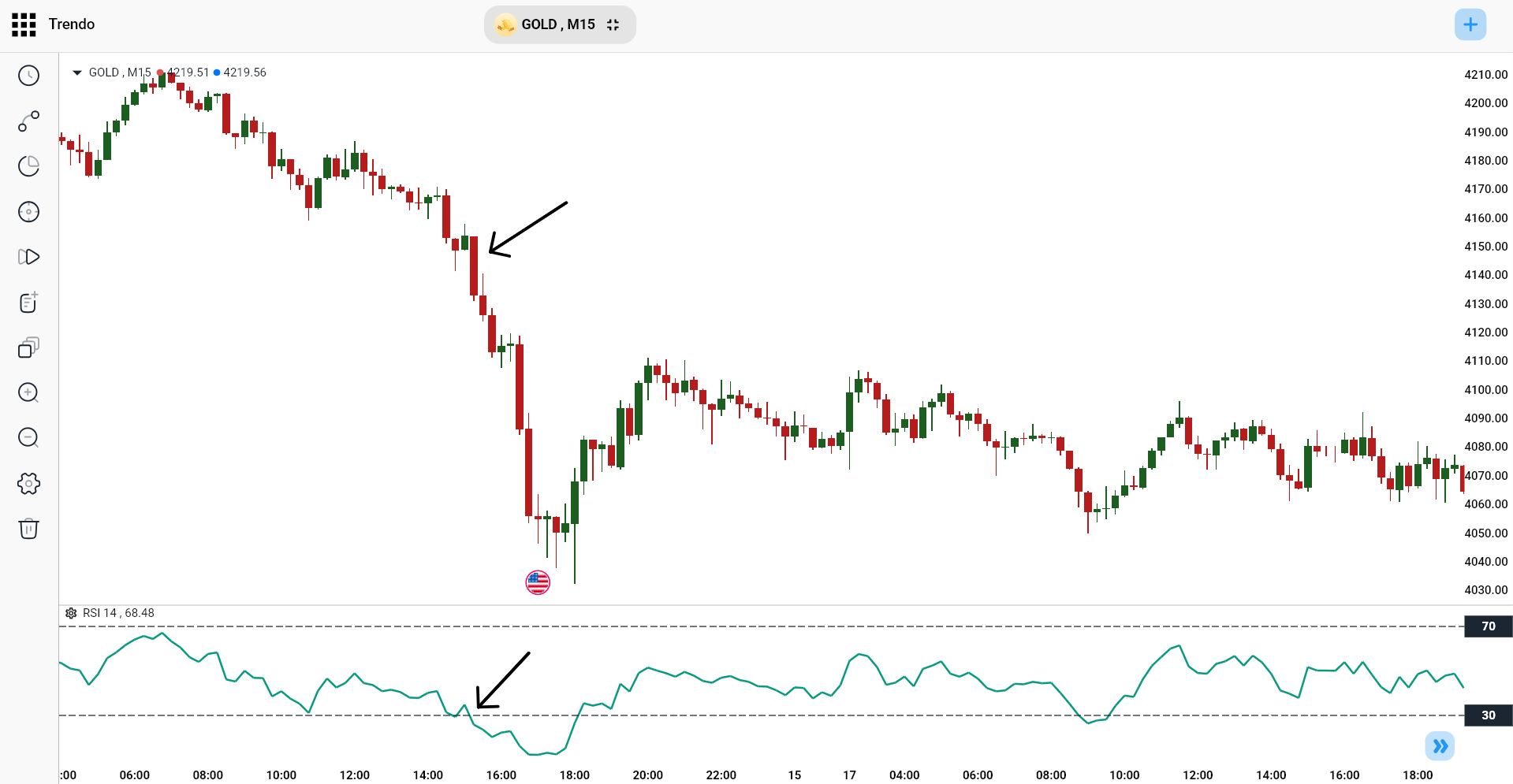
Bearish Momentum in Gold — M15 Timeframe
2) Breakout Strategy
The breakout strategy is one of the most practical approaches in trading competitions, as it enables traders to enter quickly at the start of a strong move. This strategy can be summarized in four main steps:
Step 1: Identify key support and resistance levels
Before anything else, major highs, lows, and important range zones must be identified. A level that price has tested several times but failed to break is usually the best candidate for a breakout entry.
Step 2: Wait for a valid breakout
When price approaches the desired level, traders should wait for a genuine breakout. A valid breakout is typically confirmed by a strong candle that closes above resistance or below support.
Step 3: Enter after the breakout or on a pullback
Once the breakout is confirmed, two types of entries are possible: a direct entry right after the breakout candle closes, or a more professional entry on a pullback to the broken level. Pullback entries generally offer lower risk and a more precise entry point.
Step 4: Trade management and exit
After entering, the target should be set with an appropriate risk-to-reward ratio, and profit should be protected using tools such as a trailing stop. If price returns to the previous range or signs of weakening momentum appear, a quick exit becomes essential. In trading competitions, protecting locked-in profits is often more important than waiting for the final target.
For example, as shown in the chart below, on the H1 timeframe for Gold, price initiated a strong bullish move after breaking out of the descending trendline:
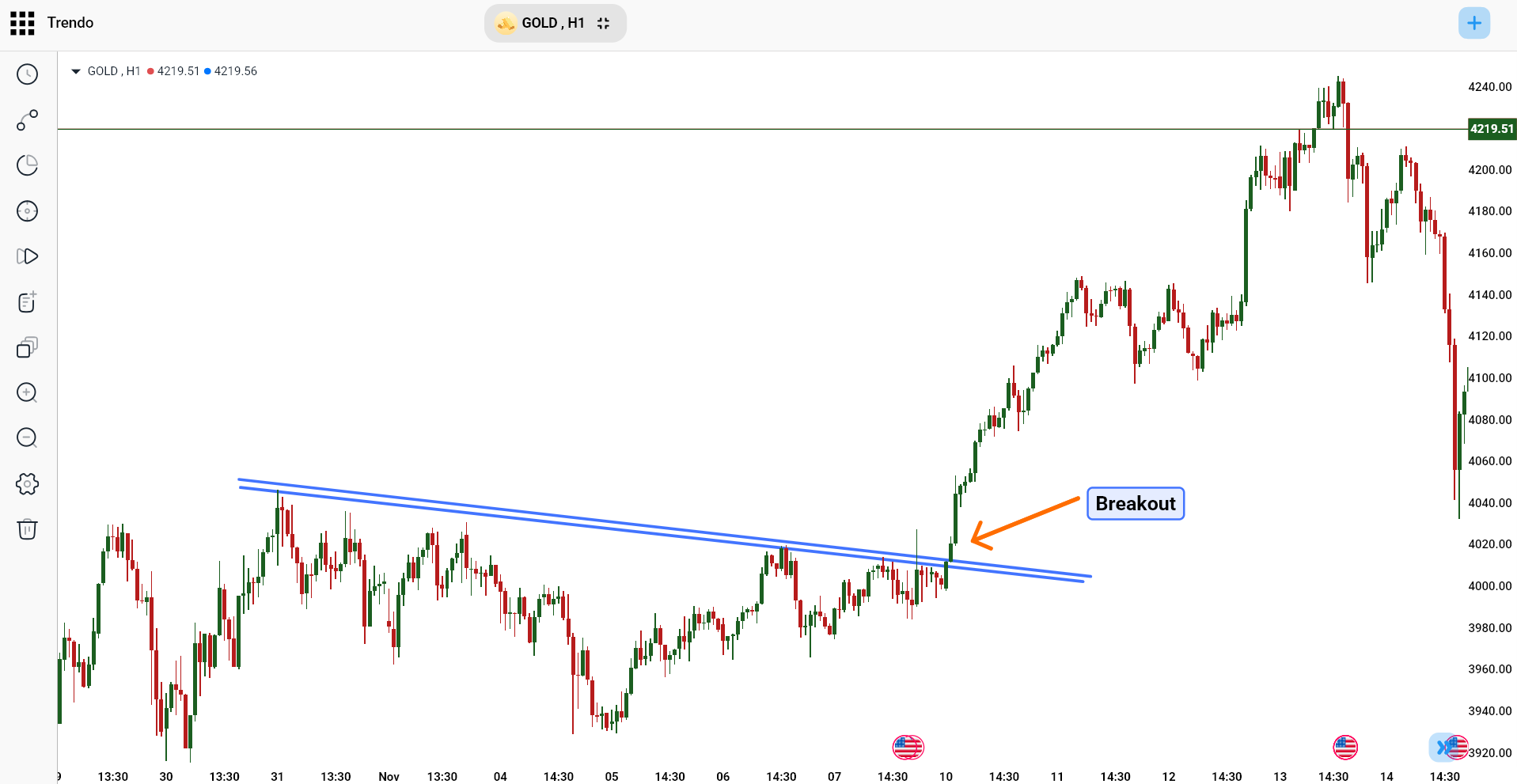
Breakout strategy on Gold – H1 timeframe
3) Moving Average Strategy
The moving average strategy is one of the simplest and most effective trading methods, and in competitions it is widely used due to the speed and clarity of its signals. This method can also be summarized in four main steps:
Step 1: Select appropriate moving averages
First, two moving averages are chosen: one short-term such as EMA10 or EMA20, and one longer such as EMA50 or EMA100.
Step 2: Identify the trend and market condition
An uptrend is confirmed when price and the short-term EMA are positioned above the long-term EMA. A downtrend is valid when price and the short-term EMA are below the long-term EMA.
Step 3: Receive entry signals from the MA crossover
A buy signal forms when the short-term MA crosses above the long-term MA in a bullish market. A sell signal appears when a bearish crossover occurs.
Step 4: Set targets and manage the position
After entering, the target should be defined with a suitable risk-to-reward ratio. As price moves, the stop-loss can be trailed gradually, or part of the position can be closed to lock in profit. Exits occur when an opposite crossover appears or when price shows a clear sign of trend reversal.
For example, as shown in the Bitcoin H4 chart below, EMA20 crossed above EMA50 and produced a bullish signal, enabling a profitable trade with a 1:3 risk-to-reward ratio.
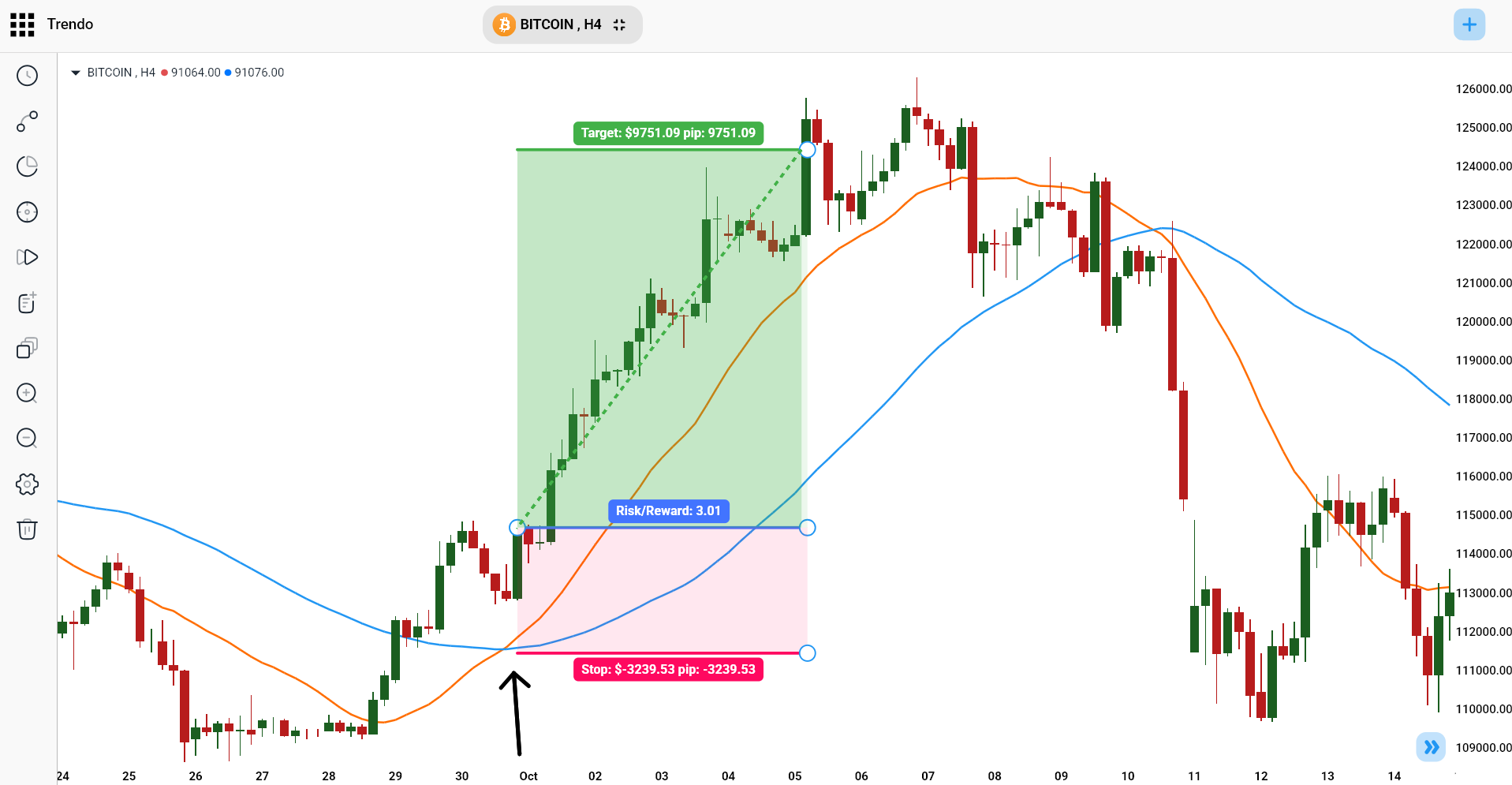
Moving Average Crossover Strategy (H4 timeframe) – Bitcoin
Trendo’s Grand Traders Competition: From Black Friday to Christmas
Trendo’s Grand Traders Competition is one of the most exciting trading events of the year, running from Black Friday to Christmas. It provides a perfect opportunity to test skills, generate profit, and compete at a professional level. In this competition, traders can place real trades and compete for attractive rewards by achieving the highest profit. The top three participants are selected based on the highest ROI and will receive the following prizes:
- 1st place: $500
- 2nd place: $300
- 3rd place: $200
In addition, Trendo also holds a $500 raffle, where 10 winners are randomly selected to receive $50 each. Therefore, even if you don’t finish in the top rankings, you still have a chance to win.
For more information and to join the Trendo competition, visit:
Trendo’s Going Black Campaign: From Black Friday to Christmas 2025
Final Words
Trading competitions are a great way for traders to prove their real skills in a competitive and engaging environment. In such events, success depends on more than just having a good strategy; it requires a combination of professional risk management, fast decision-making, emotional control, trading discipline, and selecting high-quality setups. Trendo’s Grand Traders Competition is an excellent opportunity to test your abilities and win real prizes. This contest runs from Black Friday to Christmas, allowing traders to place real trades for valuable cash rewards as well as the $500 raffle.
Register with Trendo Broker and join the trading competition